R&D programme · not a product
A business that runs itself. The hard part is not the machines.
Demertis is a research programme into the autonomous enterprise — an operation whose running, repair and improvement are carried out by software and machines rather than by people. The engineering is difficult and getting easier. The law is harder, and that is why this stays research.
- Closed operating loop
- Self-repair as architecture
- Human legal envelope
Automation stops exactly where responsibility starts
Three walls that every automation programme hits, and none of them are technical.
A person still has to sign
The system prepares the payment, the order, the shipment — and then waits, because somebody has to be accountable for it. That signature is the last human in the loop, and it is not there for technical reasons.
Automation that cannot repair itself is deferred labour
A process runs unattended until it degrades, and then a person is paged. You did not remove the work; you moved it to a worse hour and made it harder to diagnose.
Nothing improves without somebody rewriting it
The system does what it was configured to do, precisely, until a human decides otherwise. Between those decisions it does not learn anything about its own operation.
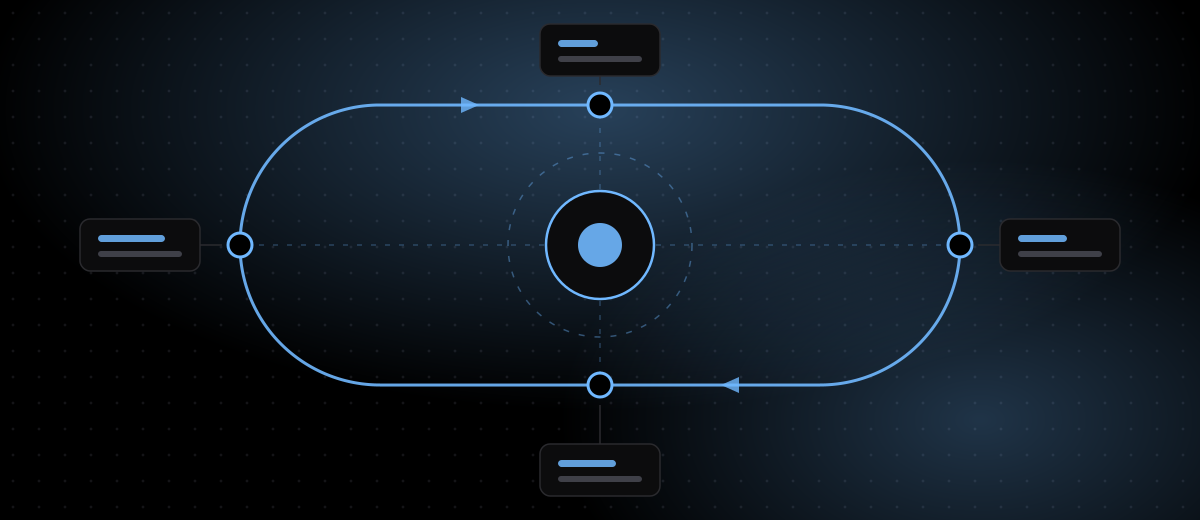
Three loops, and none of them ends at a person
Demertis is built as nested feedback loops rather than as a pipeline with a human at the end.
- 01
Operate
Sense, decide, act — across software systems and physical machines, on the same clock. The outer loop never terminates, so there is no queue of work waiting for approval to drain.
- 02
Repair
Degradation is detected by the system that is degrading, isolated, and restored — as a normal state transition rather than as an incident. No ticket is raised because there is nobody to raise it to.
- 03
Evolve
Outcomes are measured against what was expected, and the configuration that produced them is changed. Slowly, reversibly, and with every version kept, because a system that rewrites itself needs a way back more than it needs speed.
Six parts of the organism
The components under research, and the one that constrains all the others.
The closed operating loop
A control loop with no human step in it, running continuously rather than in scheduled batches. Everything else in the programme exists to make this safe enough to leave alone.
Self-diagnosis and repair
Health as a continuous signal rather than a check that runs at midnight, with restoration paths the system can execute on itself without acquiring the ability to disable its own supervision.
Physical execution
The loop reaches machines that move things, because a business that only manipulates records is not autonomous — it is waiting for somebody to load the truck.
Economic behaviour
Buying, selling, pricing and contracting as actions the loop can take, studied inside a sandbox with real market data and no real counterparties.
A ledger of every decision
What was observed, what was concluded, what was done and what happened next — written down permanently, because an autonomous system that cannot be audited afterwards is not a research result.
The human envelope
A legal owner, a defined boundary of what the loop may touch, and an interrupt the system has no path to influence. This is the part that makes the rest publishable.
Why this is research and not a product
The reason is not that the software is unfinished. It is that an autonomous cybernetic organism has nowhere to stand in law: it cannot hold obligations, own what it produces, or be liable for what it breaks. Every autonomous business today is really a human legal entity with automation inside it, and pretending otherwise would be a claim we cannot support.
- No legal personhood. Nothing in EU or Polish law lets a system be a party to anything. A company owns it, and that company is answerable.
- Liability lands on people. Whoever deployed it carries the consequences. That is correct, and it caps how autonomous the thing may actually be.
- The AI Act applies. Autonomy raises the risk classification rather than lowering the obligations, and the documentation burden grows with the loop.
- Contracts need capacity. A machine cannot agree to anything. Any economic behaviour we study runs inside a sandbox for exactly this reason.
What we are not claiming
The word organism is a description of the architecture — closed loops, self-repair, adaptation over time — and not a claim about what it is like to be one. Getting this distinction wrong is how research in this area turns into a press cycle, and we would rather be boring about it.
- Not consciousness. No claim of awareness, experience or interiority. It is a control system with a long feedback horizon.
- Not life. Self-repair and adaptation are engineering properties. Plenty of non-living systems have both.
- Not a replacement for a company. It is what a company might run one day, under a licence, with a name on the registration.
- Not deployed anywhere. No customers, no production workloads, no pilots. When that changes it will say so here.
Early, and better stated plainly
A research programme should be legible about what has actually run and what is still a diagram.
- Now
The loop on our own infrastructure
Closed-loop operation of non-regulated internal workloads, with the ledger running and the interrupt tested more often than anything else.
- Next
The physical loop
Extending the loop to machines in a controlled facility, where the failure modes stop being abstract and the safety case has to be written down.
- Later
The legal and insurance question
Working with people who do this properly — lawyers, insurers, regulators — on what an autonomous operation would have to look like to be permitted rather than merely possible.
Frequently asked questions
What is Demertis in one sentence?
A research programme into whether a business can operate, repair and improve itself without a human in the loop — and into what stops it, which is mostly law rather than engineering.
Is there anything to buy?
No. There is no product, no pilot programme and no pricing. The waitlist exists so that people who work on this can be told when there is something to read or to run.
Who is responsible if it does something wrong?
The company that operates it, which is us. That is the current legal position everywhere it matters, and we think it is the right one. It also sets the ceiling on how much autonomy is defensible today.
Could it ever have legal personhood?
It is discussed seriously in academic and policy work, and the honest summary is that no jurisdiction is close. The interesting research question is what an autonomous operation must record and constrain in order to be governable at all — which is useful whether or not personhood ever arrives.
Is it conscious, or alive?
No, and nothing in the programme is designed to test either question. Self-repair and adaptation are engineering properties of control systems. The organism framing describes how it is built, not what it is.
How do you stop it?
An interrupt outside the loop, on separate infrastructure, that the system has no path to observe or influence — and which is exercised on a schedule rather than kept for emergencies. A stop that has never been tested is a diagram of a stop.
Why do this at all?
Because the components are arriving anyway — agents, robots, cheap sensing — and the difficult questions are about accountability, auditability and shutdown. Those are better worked out in a research programme that says so than in a product that quietly ships them.
Follow the programme
The waitlist form goes live soon. Until then the blog carries the reasoning, including the parts that argue against the idea.
No form yet, no data collected — just come back.